


The 3 Big Questions Any Martial Arts History Must Answer
When people try to explain where martial arts come from, they run into three persistent puzzles:
- Why do fighting styles share so many similar techniques?
- Why do they still look and feel different across regions?
- Why do martial arts change over time—even within the same style?
Any theory of martial arts history should be able to answer all three reasonably well.
Theory #1: Centralized Origins (The “One Founder” Story)
This approach says martial arts began with one person or a small group, and later styles are offshoots from that original source.
It’s an appealing story because it’s simple and dramatic—but it has major issues:
- it often conflicts with evidence that combat systems existed earlier in many places
- it asks us to believe one group had a unique insight the world somehow missed
- it struggles to explain the huge diversity of styles if one “superior” origin existed
In short: as a broad explanation, centralized origins tends to create more problems than it solves.
Theory #2: Shared Conditions (Similar Problems, Similar Solutions)
Shared conditions theory argues that similar arts develop because:
- conflict exists in every culture (war, violence, crime)
- human bodies work the same way everywhere
Since joints bend only so far, balance breaks in predictable ways, and vulnerable targets are universal, people naturally discover overlapping techniques—even without contact.
This theory explains similarities extremely well.
Weakness: it doesn’t fully explain why some cultures emphasize:
- long-range kicking
- clinching and in-fighting
- ground grappling
- linear striking
or why styles evolve dramatically over time.
Theory #3: Great Person Theory (Innovators Change the Game)
Great person theory focuses on influential individuals who reshape training and style through:
- skill and public success
- teaching ability and charisma
- innovation in training methods or emphasis
These figures often start in existing systems, then introduce breakthroughs—especially in how techniques are practiced and tested.
This theory explains change well because a single influential teacher can:
- reorganize curriculum
- popularize a new training method
- prove effectiveness publicly and attract followers
It’s different from “one founder created everything.” It argues there are many pivotal figures across time, each pushing the art forward (or sideways).
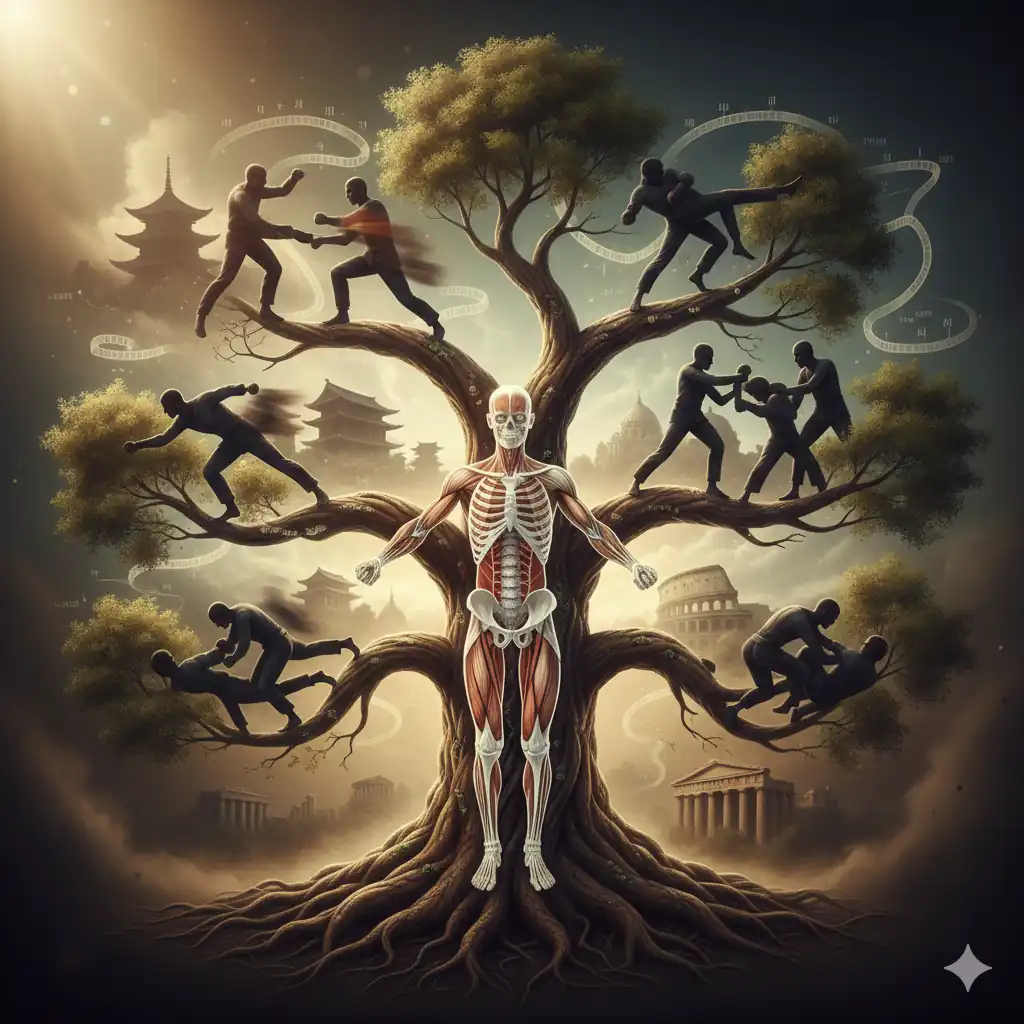
Shared human needs create overlap—culture and innovators create variety.
Theory #4: Politico-Historical Conditions (Society Shapes Combat)
This theory says martial arts evolve with political and cultural shifts.
When a society changes, so do the needs of fighting systems:
- war → weapons and battlefield skills
- peace → civilian protection and restraint tactics
- isolation → internal traditions strengthen
- modernization → old systems face pressure to adapt
For jujitsu, this helps explain why an art can shift from “supplemental battlefield skill” to “civilian self-defense system.”
Read Mor: Best Shoyoroll Gis In Stock Right Now (2026 Buyer’s Guide)
Theory #5: Sociological Class Theory (Who Trains Changes the Art)
Class structure also shapes martial arts.
If one class:
- can carry weapons
- has time and resources to train
- fights in organized warfare
their martial methods will differ from a class that: - is restricted from weapons
- needs self-defense for daily life
- trains informally or for protection
This theory helps explain why “civilian jujitsu” and “warrior jujitsu” can develop different priorities even in the same country.
The Most Realistic Answer: A Blend, Not a Single Explanation
Martial arts history usually isn’t one neat story. The most convincing approach combines:
- shared conditions (why similarities exist)
- political and class context (why styles diverge)
- great innovators (why rapid change happens)
That combined view helps you understand why martial arts:
- share common mechanics
- still develop local identity
- periodically reinvent themselves
Key Takeaway
If you want to understand jujitsu—or any martial art—don’t look for a single “origin myth.” Look for the mix of human needs, social pressures, and standout innovators that shaped what people trained, how they trained, and why those methods survived.
Want to learn more? Check out our next article here.
Theoretical Basis of Jujitsu Explained: Why Technique Beats Brute Strength
Mastering Jujitsu: The Two Foundations Every Beginner Should Understand
The Value of Martial Arts History: What Jujitsu’s Past Teaches Modern Students