
Albino & Preto (often shortened to A&P) sits in a unique lane inside Brazilian Jiu-Jitsu: it’s not “just” a gi brand and it’s not “just” streetwear either. It’s a release-driven system where design language, limited availability, construction details, and storytelling all matter as much as performance on the mat.
If you’ve ever wondered why some A&P drops feel like major events, why certain models repeat in subtle ways, or how to tell a “daily trainer” from a collector piece at a glance—this guide is built to make the entire ecosystem simple and usable. It’s based on consolidated release records across many years of drops and organizes everything into the same buckets A&P releases naturally fall into: Batches, Classic, Specials, Brazil Series, and the modern competition line now branded as Competition Workwear.
The A&P “System”: Why the Brand Feels Bigger Than Any Single Gi
A&P is easiest to understand as a system with a few consistent ideas:
The brand uses recurring “families,” not one-off randomness
Even when themes change, the brand repeatedly returns to recognizable families and sub-series—things like competition-focused runs, “classic” builds, herringbone/classic variations, quick-strike style drops, and named or themed batches that behave like capsules (gi + apparel + accessories). You can see this pattern clearly across the long index of releases and variants.
Drop mechanics are part of the product
A release isn’t only “what the gi is,” but also:
-
whether it’s regional (Japan/Europe/US timing),
-
whether it’s Reserve vs Public (two-step launch),
-
whether it’s capsule-sized (gi + tees + rashguards + shorts),
-
whether it has purchase limits or special access.
These mechanics matter because they change how you prepare—and what kind of buyer experience you’re actually stepping into.
A&P’s design philosophy is “minimal first, story second”
A&P can go loud with theme graphics, but the baseline aesthetic tends to be controlled: clean silhouettes, careful palette choices, and construction that’s meant to feel premium even when the outside looks simple. You can see that especially clearly in the recurring “Classic” line, where the language is all about refining a staple silhouette rather than reinventing it.
How A&P Releases Are Organized: The Five Buckets You Need to Know
If you want to understand A&P quickly, stop thinking in “best gi lists” and start thinking in these buckets:
1) Batches (the main universe)
The largest bucket—numbered drops, themed runs, and the bulk of A&P history.
2) Classic (the quiet backbone)
Seasonal/quarterly-style staple builds with small-but-important construction updates, often staying in an intentionally restrained palette.
3) Specials (collabs and one-offs that don’t behave like normal batches)
These are “headline drops” that don’t necessarily fit the standard numbered batch playbook—often true partnerships or special projects.
4) Brazil Series (Made-in identity and origin-driven runs)
A separate lineage where origin and build are part of the story. Multiple entries explicitly call out being made in Brazil, contrasted with the typical manufacturing location used for many other releases.
5) Competition Workwear (the modern competition-compliant evolution)
This is a recent “competition uniform” concept presented as a refined line that replaces the older RS series, with stated construction choices like a 380gsm pearl weave top and updated pants with an elastic waistband.
Batches: The Release Engine That Built the A&P Reputation
Batches are the reason A&P has collector culture. They’re also why newcomers feel overwhelmed: there are a lot of them, and they aren’t all the same type of product.
What “Batch” usually means in practice
A batch is typically a themed or categorized release that may include:
-
a gi (often the centerpiece),
-
apparel (tees, rashguards, shorts),
-
graphics or iconography tied to the story,
-
limited availability, sometimes region-gated or time-windowed.
You can also see how A&P sometimes repeats “sub-series” inside the batch universe—like herringbone classics, competition variations, essential builds, and quick-strike style drops.
The Three Big “Batch Styles” You’ll Encounter
1) Capsule collaborations (pop culture, music, entertainment)
These are the releases that feel like full campaigns, often including multiple apparel items and heavy theme integration.
Example: SpongeBob capsule
One collaboration is documented as US-store only, with a Reserve pre-sale window open for only ten minutes, followed by broader availability, and a capsule that included a themed gi and tees (adult and kids).
Example: TMNT capsule
Another similar collab follows the same high-urgency pattern (US-store only, 10-minute Reserve window) and includes extensive theme elements across the gi and detailing.
Example: Star Trek project
A separate project is described as a special collaboration including not only kimonos but also tees, a long-sleeve rash guard, and training shorts, with iconography integrated across the capsule.
Example: Wu-Tang collaboration
A music collaboration is documented as a heavily themed build with a distinctive palette and expanded merch universe (including apparel and additional items beyond the gi).
What these have in common: you’re buying a universe, not only a uniform. If you’re a collector, these are often the most emotionally “sticky” because they connect the mat to something outside the sport.
2) Culture and concept themes (heritage, symbolism, seasonal narratives)
Not all stories are pop culture. Some batches lean into meaning, cultural motifs, or concepts meant to resonate with training.
Example: Year of the Dragon
A themed collection is described as celebrating a major zodiac symbol, connecting cultural symbolism to the brand’s design direction.
Example: Satori
A release is positioned as heritage/lineage-driven, with the theme explicitly tied to the meaning of “sudden enlightenment,” and the design described as detail-heavy.
Why this matters: these drops often age well, because they aren’t locked to a single pop trend. They feel like “A&P stories,” not “licensed campaigns.”
3) Utility/performance-inspired batches (the “serious” lane)
A&P also has a history of releases that read more like engineered tools than art pieces.
Example: Mil-Spec
A named batch exists in the archive as part of the broader lineup of utilitarian/performance concept drops and later connects to the Brazil-made MIL-SP lineage.
This is where you’ll find many of the gis that people train hard in—often less “collectible hype,” more “I want something durable that still feels A&P.”
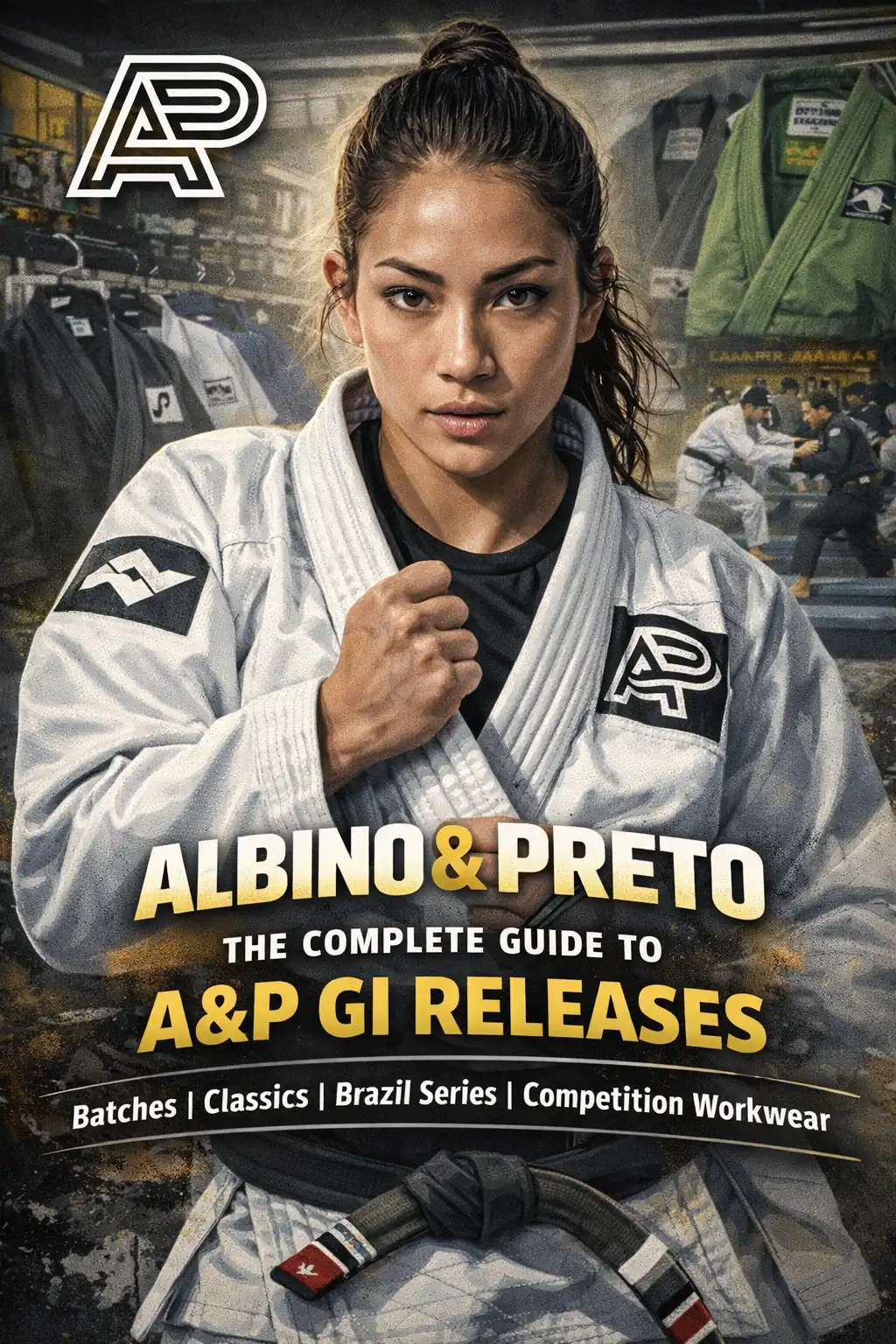
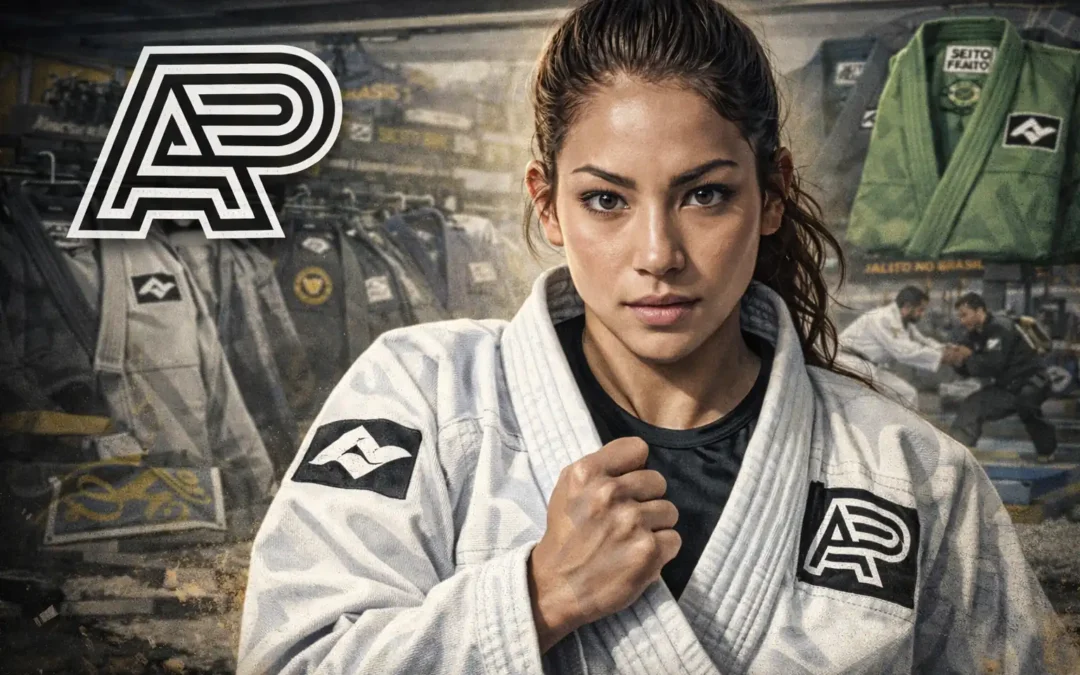
A young female athlete demonstrates her focus in a white Albino & Preto gi, showcasing the brand’s premium BJJ gear against the backdrop of a busy training environment. The Albino & Preto logo stands out in the top corner, representing the brand’s commitment to both performance and style in Brazilian Jiu-Jitsu.
Classic Line: Minimal, Refined, and Quietly Upgraded
If Batches are the fireworks, Classic is the steady flame.
What “Classic” is really for
The Classic line is the easiest entry point for people who:
-
want A&P construction and brand identity,
-
prefer a cleaner look,
-
don’t want to chase ultra-themed collector drops,
-
want something that still feels premium and intentional.
Classic construction trends you’ll see repeated
Across multiple Classic entries, the records emphasize updates like:
-
higher hip seam pattern,
-
overlocking jacket seams,
-
rounded skirt slits,
-
heavy taped openings,
-
and consistent base fabrics such as a 450 GSM pearl weave jacket with 10oz cotton/canvas pants.
This matters because it shows Classic isn’t “basic.” It’s “refined.”
Classic releases evolve like seasons, not like hype cycles
Classic 18 Q1: the blueprint
One Classic entry describes “breathing new life into a staple silhouette” while keeping the palette consistent, and it lists a 450 GSM pearl weave top paired with 10oz canvas cotton pants.
Classic 18 Q4: the staple, updated
A later Classic entry lists specs in the same spirit (450g pearl weave top + 10oz canvas bottom), alongside structured release details like color availability and purchase limits.
Classic 19 Q1: continuity with small evolution
A subsequent Classic entry continues the same core spec language while updating color options and release details.
Takeaway: Classic is the “if you know, you know” lane. It often looks understated, but it’s where the brand quietly improves fit and construction without screaming about it.
Brazil Series: When Origin and Build Are the Story
The Brazil Series is one of the most important concepts to understand if you care about:
-
collector value,
-
brand heritage,
-
or “why this model feels different.”
The defining idea: Made-in Brazil as a point of differentiation
One Brazil Series entry explicitly contrasts its manufacturing location with what’s typical for many other releases, stating that this series is made in Brazil while most A&P releases are made elsewhere.
That single detail changes how collectors view these drops. It becomes “part of the identity,” not a footnote.
How Brazil Series drops often behave
Brazil Series entries frequently include:
-
regional schedules (Japan/Europe/US release dates),
-
clearly stated specs (often 415g pearl weave + 10oz pants),
-
broader size runs including “H” and “F” variants (depending on entry),
-
and a positioning that feels like “core heritage” rather than “theme-of-the-month.”
Two Brazil Series examples that clarify the lineage
Series 1 Brazil: the “statement”
A Series 1 entry highlights Brazil manufacturing as the defining differentiator and frames the release as an early milestone.
Series 17 Brazil: modern Brazil series clarity
A later Brazil Series entry lists:
-
a multi-region release schedule (Japan/Europe/US Reserve/Public),
-
415g pearl weave top,
-
10oz cotton pants,
-
and a broad set of sizes.
MIL-SP Brazil DP.1: Brazil Series meets utility design
A MIL-SP Brazil DP.1 entry emphasizes 415g pearl weave and positions the fabric as balancing durability and breathability for intense use.
What this tells you: Brazil Series isn’t just “made in a different place.” It often sits at the intersection of heritage + performance intent.
Specials: The Drops That Don’t Play by “Batch Rules”
Specials are where you’ll see A&P stepping into co-branded territory in a way that feels bigger than a numbered drop.
A&P x SYR Adrenaline: co-branded and access-gated
One special project is described as a renewed partnership after multiple years, with the concept built around racing/adrenaline as a metaphor for competitive drive, and it includes access restrictions where a particular colorway was limited to specific groups (including Reserve membership).
Why Specials matter: they often become reference points in the brand timeline—moments people remember, not just releases people wore.
Competition Workwear: The Modern “Serious Competitor” Direction
If you compete—or you train like you do—this is the category to understand.
The headline shift: replacing the RS series
A competition entry introduces the brand’s “Competition Workwear” concept as a refined competition-compliant uniform designed to replace the RS series.
What Competition Workwear is designed to do
The description focuses on:
-
a specific silhouette (MN001),
-
maintaining range of motion without sacrificing durability,
-
a rigid 380gsm pearl weave top aimed at day-to-day toughness,
-
and updated pants described as Novo pants with an elastic waistband.
Practical takeaway: if you want an A&P gi that’s built as a competition tool first (and a collectible second), this line is meant to be that answer.
How A&P Collaborations Expand Beyond Gis
A&P isn’t only selling a gi. Many releases are designed as “mat-to-street” collections.
Apparel is not an afterthought
Multiple collaboration entries explicitly include tees, rash guards, and shorts as part of the project—meaning the brand intends the release to live beyond training sessions.
Collaborations also act as “brand bridges”
A partnership with a retailer known for streetwear and culture is described as celebrating global travel and competition, and it’s positioned as a capsule concept, not just a gi drop.
This is important because it explains how A&P grows: the gi is the anchor, but the culture is the amplifier.
Understanding Drop Mechanics: Reserve, Public, Regions, and Limits
If you want to actually buy A&P at retail, the mechanics matter as much as the product.
Reserve vs Public: the two-step rhythm
Some releases document a clear “Reserve” phase (early access) followed by a “Public” phase—sometimes the very next day.
Tiny windows are real
At least two major collaborations are documented with a Reserve pre-sale window that lasted only ten minutes.
Purchase limits change buyer behavior
Some releases list “none,” while others restrict buyers to one colorway per customer or similar constraints.
Regional scheduling is a feature, not a bug
Brazil Series entries show structured region timing (Japan, Europe, then US Reserve/Public).
Best practice: if you treat an A&P drop like normal shopping, you’ll miss it. Treat it like a limited launch: know the time, know your size, know your plan.
The Role of Membership: Why “Reserve” Changes Everything
A&P’s Reserve concept shows up repeatedly as a gatekeeping layer—sometimes for early access, sometimes for exclusive colorways, and sometimes as part of a membership package.
Reserve membership can include gear bundles
A documented Reserve package includes a membership kit featuring items like a kimono and rash guard among other pieces, making Reserve more like an ecosystem than a newsletter.
Reserve can unlock exclusive access
Some specials explicitly restrict certain versions to Reserve members or other region-based groups.
Collector takeaway: Reserve status can become part of the resale story, because it affects who had access to what—especially for restricted colorways.
Fabric and Spec Patterns: What A&P Uses (and Why It Matters)
You don’t need to memorize every model, but you should recognize the common spec language.
450 GSM pearl weave + 10oz pants: the common premium baseline
Multiple Classic entries specify a 450 GSM pearl weave top paired with 10oz canvas/cotton pants, signaling a “durable but not absurdly heavy” build aimed at long-term training.
415g pearl weave in Brazil Series and MIL-SP Brazil variants
Brazil Series entries list 415g pearl weave and 10oz cotton pants, reinforcing a consistent build identity across the made-in lineage.
380gsm pearl weave for the competition workwear direction
Competition Workwear is described using a 380gsm pearl weave jacket, paired with updated pants designed for function (including an elastic waistband).
Simple interpretation:
-
450g often signals a premium “daily driver” feel in Classic and many batches.
-
415g in Brazil Series often signals a balance of tradition + performance.
-
380g in Competition Workwear signals a purposeful competition tool orientation.
Collector Culture and Resale: Why Certain A&P Releases Appreciate
A&P resale isn’t random. It tends to follow three factors:
1) Story intensity
Licensed collaborations and big cultural partnerships often hold attention longer because they remain easy to talk about years later (e.g., entertainment or music-based capsules).
2) Access restrictions
If a release was US-only, region-gated, Reserve-first, or had an extremely short pre-sale window, it naturally creates fewer owners and higher long-term demand.
3) Material or lineage differentiation
Made-in Brazil differentiation and series identity can add collector appeal because it’s not just “a cool design,” it’s a different lineage.
How to Choose the Right A&P Gi for Your Training Style
If you only take one thing from this guide, take this: the “best A&P gi” depends on what you do on the mat.
If you train 4–6 days a week and want one dependable gi
Start with Classic. It’s built around refinement, durability, and minimal design—without the pressure of chasing heavy theme.
If you compete often and want a purpose-built uniform
Look toward the Competition Workwear line because it’s explicitly positioned as a competition-compliant replacement for the older RS concept, with construction choices made for repeat use.
If you love themed drops and want pieces that spark conversation
Explore Batches, especially capsule collaborations and story-driven concepts. These are the “collector heart” of the brand.
If you care about lineage, origin, and “made-in” identity
Browse the Brazil Series and Brazil-linked MIL-SP entries.
If you collect cross-brand history
Watch Specials for partnership moments that sit outside standard batch logic.
Buying Strategy: How to Stop Missing Drops
Step 1: Identify your category first
Know whether you’re targeting:
-
Classic (staple),
-
Brazil Series (heritage),
-
Competition Workwear (tool),
-
Batches (story),
-
Specials (moment).
This prevents impulse buys and helps you focus.
Step 2: Treat launches like launches
If a release has a short access window, you don’t “shop,” you execute:
-
save your size,
-
be logged in early,
-
know your backup choice,
-
accept that the drop might sell out fast.
The documented ten-minute Reserve windows are a perfect example of why preparation matters.
Step 3: Respect region timing
Especially for Brazil Series, timing may differ across Japan/Europe/US, sometimes including Reserve and Public separation.
Care and Longevity: How to Keep Your A&P Gi Looking Sharp
A&P gis often look best when they’re clean, crisp, and not overly “tumbled.”
Washing (simple and safe)
-
Cold wash helps preserve color and stitching contrast.
-
Turn the gi inside out to reduce abrasion on patches and embroidery.
-
Skip harsh detergents that can dull blacks and dark trims.
Drying
-
Air dry whenever possible.
-
If you use heat, use it sparingly—especially for preserving fit consistency.
Storage
-
Don’t store damp.
-
For collector pieces, avoid direct sunlight (keeps whites from yellowing and blacks from fading).
Albino & Preto Release Blueprint: A Collector’s Guide to Understanding Product Categories and Drop Mechanics
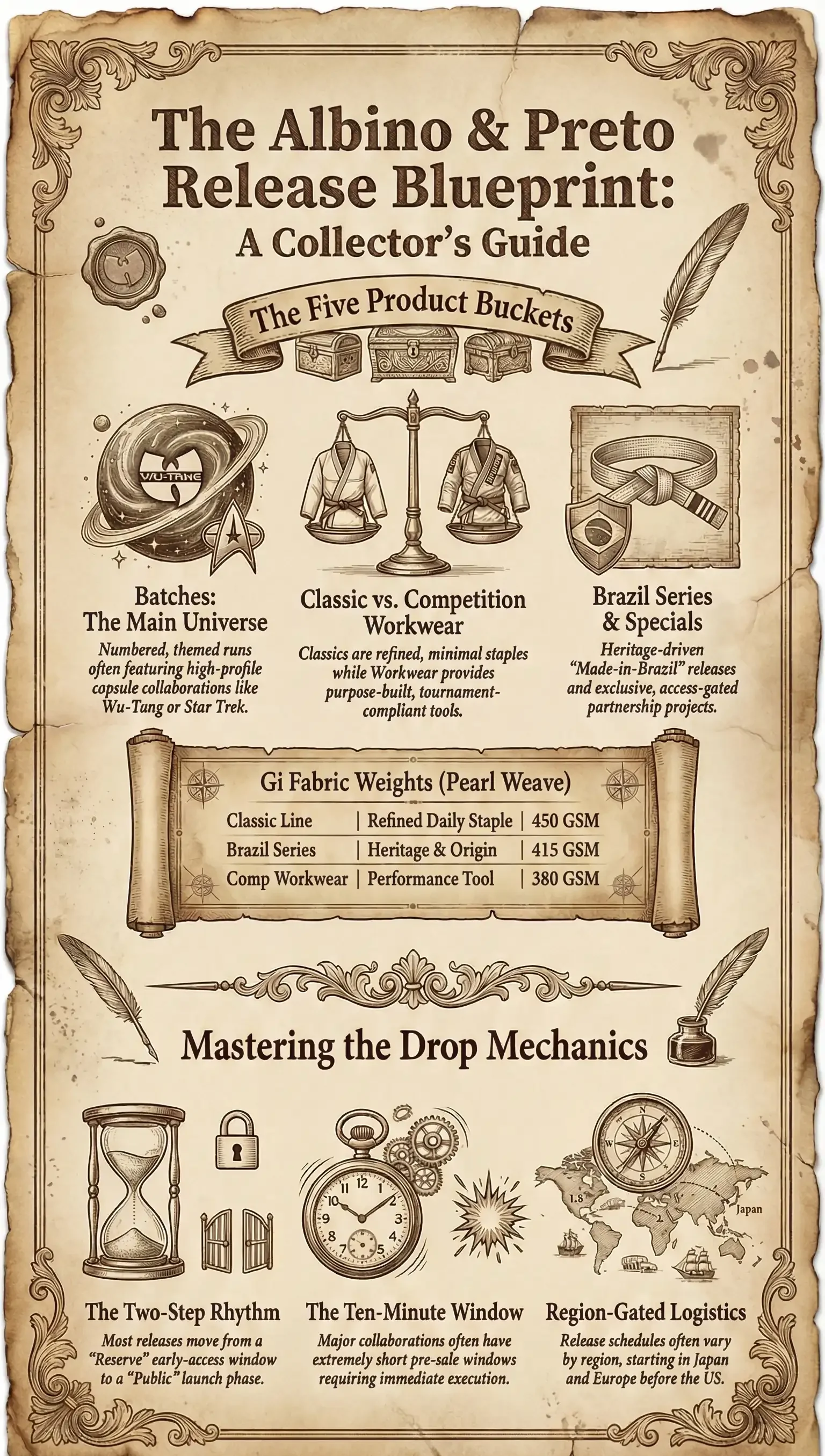
An informative guide to Albino & Preto’s unique release system, detailing the five product buckets, gi fabric weights, and essential drop mechanics. This collector’s guide helps navigate A&P’s BJJ gi collections and limited release strategies
Albino & Preto Product Lineup: Old, New & Current Releases (Complete Index)
Older / Archive Albino & Preto product names (early + legacy)
-
Batch #1
-
Batch #2: Creative Transitions
-
Batch #5: V3
-
Batch #7: Grey Skies
-
Batch #9: Worlds 2016
-
Batch #10: A&P x Cukui
-
Batch #12: M90
-
Batch #14: Galaxy
-
Batch #16: New York
-
Batch #17: Pinktober
-
Batch #21: Adapt and Overcome
-
Batch #23–#26: Quick Strike #1–#3 + 2017 Q4 Reserve Quick Strike
-
Batch #27–#28: Royal Pack (White / Black)
-
Batch #31: Snakes
-
Batch #33: Bodega x A&P World Domination
-
Batch #35: Heritage
-
Batch #41–#42: Stealth Black / Stealth White
-
Batch #45: Paisley
-
Batch #48: Q2 Competition
-
Batch #53: RS350
-
Batch #60: Mil-Spec
-
Batch #62: Herringbone Classic
-
Batch #63: Bearbrick
-
Batch #70: Supernova
-
Batch #72: Satori
Brazil Series (legacy line):
-
Series 1 Brazil through Series 17 Brazil
-
MIL-SP Brazil DP.1
Newer / Recent Albino & Preto product names (modern era drops)
-
Batch #90: Essential Kimono
-
Batch #92: Garfield
-
Batch #97: Stash
-
Batch #99: Quilted Kimono
-
Batch #100: Star Trek
-
Batch #103: Wu-Tang
-
Batch #104: Hot Wheels
-
Batch #108: Stained Glass
-
Batch #110: Year of the Tiger
-
Year of the Dragon
-
GAS Herringbone Classic
-
Ollin
-
Accelerate
-
RNG Comp
-
Elektronic
-
Workwear
-
VGB Comp
-
Wrasse
-
SFOS Herringbone Classic
-
POC Herringbone Classic
-
OBY Herringbone Classic
Current Albino & Preto product names (official store categories right now)
Kimonos / Gis (examples currently listed):
-
A&P TOUGH LOVE GI
-
A&P BBBW HERRINGBONE GI (Black / Blue / White)
-
A&P WRASSE GI (Green / Navy)
-
A&P VGB COMP GI (Black / Royal / White)
-
A&P WORKWEAR GI (Black / Royal / White)
-
A&P ELEKTRONIC GI
-
A&P ACCELERATE GI (and A&P ACCELERATE GI RESERVE)
-
A&P x DICKIES® GI (Navy / Lincoln Green)
-
A&P x BOB MARLEY ‘UPRISE’ GI
-
A&P x GOODFIGHT® GI BLACK
-
A&P x STASH SUBWARE® (Full Camo GI / Half Camo GI)
-
A&P x HUF® “WAIT WHAT!” GI
-
A&P x REALTREE® ORIGINAL HALF CAMO GI
-
A&P x WIND AND SEA® GI
-
A&P x NESM GI (Navy / Unbleached)
-
A&P MIL SP BRAZIL GI ROYAL
No-Gi / Training (examples currently listed):
-
A&PWW LS RANKED RASHGUARD (Black)
-
A&PWW SS RANKED RASHGUARD (White / Blue)
-
3” A&PWW NOGI LOOSE SHORTS
-
5” A&PWW NOGI LOOSE SHORTS
-
A&P BBBW LS RASHGUARD
-
A&P BBBW SHORTS
-
A&P WRASSE LS RASHGUARD (Green / Navy)
-
A&P WRASSE SHORTS (Green / Navy)
-
A&P VGB COMP SS RASHGUARD
-
A&P VGB COMP SHORTS
Apparel (examples currently listed):
-
A&P BBBW MARK TEE (Black / White)
-
A&PWW RINGER CREWNECK (Black)
-
A&PWW ESSENTIAL TEE (White)
-
A&P ROTTEN INTENT TEE
-
A&P x OAKLEY® VARSITY JACKET (PRE-ORDER)
-
A&P x BOB MARLEY tees (multiple graphic names listed)
Accessories (examples currently listed):
-
AP x ’47 TT CLEAN UP HAT (multiple colorways)
-
APWW SKULLY BEANIE
-
A&P® x OAKLEY® FROGSKINS HYBRID™
Frequently Asked Questions
Is A&P mainly a collector brand or a training brand?
Both. Classic and competition-focused runs exist for heavy training, while batches and specials build collector culture.
Why do some drops include apparel and others don’t?
Capsule collaborations and special projects often expand into tees/rashguards/shorts, while staple lines focus on the uniform itself.
What’s the easiest way to understand A&P naming?
Treat “Batch” as the main universe, “Classic” as the staple silhouette line, “Brazil Series” as the made-in lineage, “Specials” as partner moments, and “Competition Workwear” as the modern competition uniform concept.
The Bottom Line: A&P Makes More Sense When You See the Blueprint
Albino & Preto isn’t built around a single flagship model. It’s built around a blueprint:
-
Batches create culture, emotion, and collectible moments.
-
Classic keeps the brand grounded with refined staples and consistent premium specs.
-
Brazil Series anchors heritage and “made-in” identity as a meaningful differentiator.
-
Specials mark partnership milestones and access-gated projects.
-
Competition Workwear signals a serious evolution toward modern competitive uniforms.
Once you learn those lanes, the brand stops feeling chaotic—and starts feeling like what it really is: a structured release universe where design, function, and culture move together.