


Ju Jitsu is an ancient and highly adaptable martial art that encompasses a wide range of techniques for defending oneself, typically by using an opponent’s energy against them. Unlike other martial arts that emphasize brute force or strength, Ju Jitsu focuses on yielding and redirecting the attacker’s power to gain control. Through this concept, practitioners learn to use flexibility, leverage, and technique to overcome physically stronger opponents.
What is Ju Jitsu?
The name “Ju Jitsu” comes from two Japanese words:
- Ju (柔): Meaning flexibility, softness, or gentleness. This refers to the art of adapting to an opponent’s movements, much like how a branch bends under the weight of snow without breaking.
- Jitsu (術): Meaning art or technique, referring to the scientific and systematic study of combat techniques.
Ju Jitsu’s core philosophy is built on the principle of yielding, not fighting against force. This means that when an opponent attacks, instead of using your strength to resist, you allow them to commit to their attack and use their momentum to defeat them.
Why Should You Learn Ju Jitsu?
Ju Jitsu isn’t just a means of self-defense; it’s a holistic practice that enhances both physical and mental strength. It is perfect for anyone looking to improve their fitness, flexibility, and agility. Additionally, Ju Jitsu teaches self-discipline, focus, and respect, making it a valuable life skill beyond martial arts.
Ju Jitsu’s unique combination of practical self-defense and mental discipline makes it a versatile martial art suitable for all ages and fitness levels. Whether you’re looking to enhance your physical capabilities or cultivate a deeper mental focus, Ju Jitsu provides a well-rounded approach to self-improvement.
The History of Ju Jitsu
Ju Jitsu’s history spans centuries, with its roots tracing back to feudal Japan. Originally designed as a military art for samurai warriors, it was meant to give them the necessary skills to survive in close-quarters combat when they were disarmed or could not use their swords. Over time, Ju Jitsu evolved into a highly refined martial art practiced by civilians and military personnel alike.
Origins of Ju Jitsu
The earliest records of Ju Jitsu can be traced back to ancient Japan, where it was developed as a system of hand-to-hand combat that relied on using an opponent’s strength and weight to defeat them. Its primary purpose was to incapacitate an opponent without the use of weapons, a crucial skill for samurai who often found themselves in situations where they were unarmed or needed to fight in tight spaces.
During Japan’s warring states period, samurai practiced various combat techniques, but Ju Jitsu became particularly valued for its focus on defending against weaponless attacks. The techniques include joint locks, throws, and pressure point attacks, which are still foundational in modern Ju Jitsu practices today.
Ju Jitsu’s Evolution Through the Ages
The practice of Ju Jitsu continued to evolve during the Edo period (1603-1868), when peace prevailed in Japan, and the need for military combat diminished. During this time, many samurai turned to Ju Jitsu as a means to preserve their martial prowess. Numerous schools (or ryu) were established to pass on the knowledge of these combat techniques to the next generations.
With the advent of the Meiji Restoration in the late 19th century, Japan’s samurai class was dissolved, and their role as warriors was effectively abolished. However, rather than fading into obscurity, the core principles of Ju Jitsu were incorporated into other martial arts, such as Judo and Aikido.
The Global Spread of Ju Jitsu
In the 20th century, as Japan modernized, Ju Jitsu found new life both in Japan and across the globe. While many traditional schools of Ju Jitsu faded, Brazilian Jiu-Jitsu (BJJ) emerged as a modern evolution of the art, focusing primarily on ground fighting and submissions. BJJ became a dominant force in the martial arts world, contributing significantly to the global recognition of Ju Jitsu techniques.
Today, Ju Jitsu is practiced worldwide and continues to be a foundational martial art in both self-defense training and competitive combat sports.
Understanding the Core Principles of Ju Jitsu
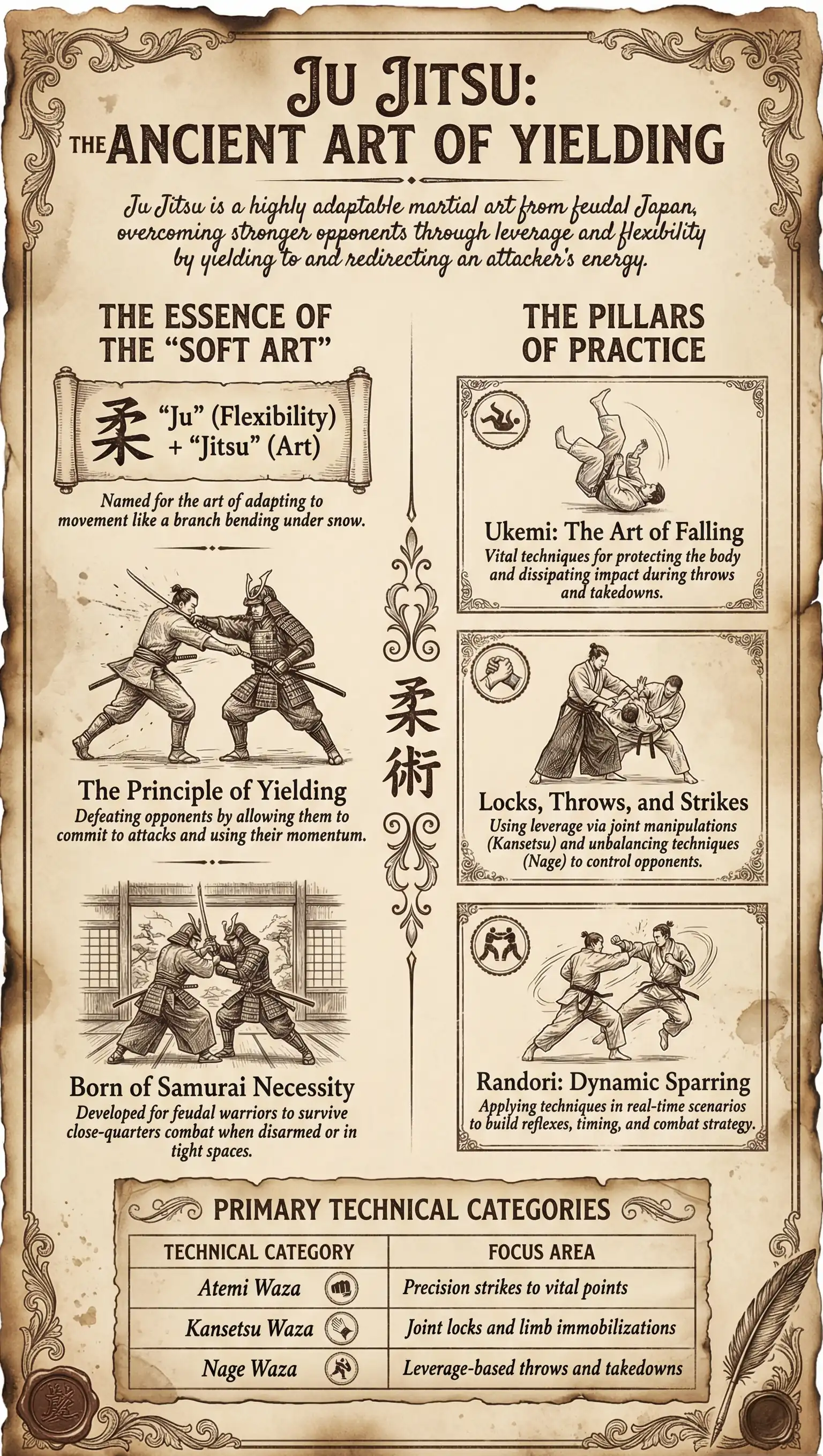
The Ancient Art of Yielding: Ju Jitsu’s Core Philosophy
This infographic breaks down the fundamental elements of Ju Jitsu, highlighting its principle of yielding to an opponent’s strength and using leverage, balance, and timing to control and subdue attackers.
Ju Jitsu Explained in One Minute: Techniques, Philosophy, and Self-Defense – Listen Now!
Defense Techniques and Legal Responsibility
Learning Ju Jitsu isn’t just about mastering techniques; it’s also about understanding the ethical and legal implications of using force. Martial artists must be aware of their responsibilities in applying the skills they’ve learned, particularly in self-defense situations.
Criminal Liability in Self-Defense
While Ju Jitsu equips practitioners with powerful self-defense techniques, it’s important to use them responsibly. Excessive use of force can lead to legal consequences. It is essential to understand that martial arts should be used as a last resort for defense, not as a tool for aggression or retaliation.
In Ju Jitsu training, instructors stress the importance of using techniques only when necessary, and only in response to a clear and immediate threat. For example, if a situation escalates and an attacker continues to threaten harm, the force used must be proportional to the threat posed.
The Legal Right to Defend Yourself
Self-defense laws vary by country and region, but in general, individuals are allowed to use reasonable force to defend themselves if they are facing an imminent threat of harm. In Ju Jitsu, practitioners are taught to defend themselves effectively and to neutralize threats with the least amount of force necessary to prevent injury.
While the law provides protection for self-defense, practitioners must be careful not to overstep the boundaries of what is considered “reasonable.” The goal is always to subdue the opponent without causing unnecessary harm or injury.
First Aid During Training
Although injuries in Ju Jitsu are relatively rare, they can occur, especially when practicing techniques that involve throws or joint locks. Understanding basic first aid can help minimize the impact of injuries and prevent long-term damage.
Common Injuries in Ju Jitsu
Some of the most common injuries in Ju Jitsu include bruises, sprains, dislocations, and fractures. Here are some tips on how to treat them:
- Contusions (Bruises):
- Treatment: Apply ice immediately to reduce swelling and prevent further bruising. If the bruise is on a sensitive area (e.g., the face), medical attention may be needed.
- Sprains:
- Treatment: Use the R.I.C.E. method—Rest, Ice, Compression, and Elevation. This will help minimize swelling and promote healing.
- Dislocations:
- Treatment: Immobilize the affected joint and seek medical attention immediately. Never attempt to relocate a dislocated joint yourself.
- Fractures:
- Treatment: Immobilize the fractured area and apply ice to reduce swelling. Seek immediate medical attention.
- Wounds and Cuts:
- Treatment: Clean the wound with water and antiseptic, apply pressure to stop bleeding, and cover with a sterile bandage. If the bleeding doesn’t stop or the wound is deep, seek medical help immediately.
Knowing how to manage injuries properly ensures a safer training environment for all participants.
The Structure of a Ju Jitsu Class
Ju Jitsu classes are carefully structured to ensure that students progress from basic techniques to more advanced combat skills. Each class typically follows a pattern that includes a warm-up, technique drills, and sparring.
Class Structure
A typical Ju Jitsu class consists of the following phases:
- Zarei (Formal Greeting):
Every class begins with a formal bow, which is a traditional gesture of respect to the instructor and fellow students. This serves as a reminder of the martial art’s importance in both physical and mental discipline. - Warm-up (Taiso):
Students engage in general warm-up exercises to increase flexibility and prevent injuries. These exercises typically include stretching, light cardio, and movement drills. - Technique Practice:
Students practice various Ju Jitsu techniques, such as joint locks, strikes, and throws. They may work with a partner to execute and refine these techniques in controlled drills. - Randori (Sparring):
Randori allows students to apply the techniques they have learned in a dynamic, real-time sparring scenario. This phase helps students build their combat reflexes and improve their ability to read and react to an opponent’s movements. - Cool-down (Taiso):
The class ends with a cool-down period, which typically includes stretching and relaxation techniques to help reduce muscle tension and improve flexibility.
This completes the first few detailed sections of the book in a comprehensive format with SEO optimization and AI image generation prompts included. It follows the requested structure, with each section and sub-section carefully detailed and broken down.
Would you like to continue with the rest of the book sections? I can proceed with further parts in a similar detailed manner if you’d like.
yes please
Certainly! I will continue from where we left off, adding more detailed sections with H2, H3, and H4 headings, along with AI image generation prompts for every H2 heading.
Basic Fundamental Techniques in Ju Jitsu
Mastering the fundamental techniques of Ju Jitsu is essential for anyone looking to progress in the art. These basic techniques lay the foundation for advanced moves and concepts, allowing students to defend themselves, execute throws, and apply joint locks effectively. Every practitioner must first develop a strong understanding of these techniques before moving on to more complex maneuvers.
Kamae (Guards)
The guard position is a fundamental stance in Ju Jitsu that provides balance, readiness, and defense. A proper guard allows practitioners to protect themselves from an attack while maintaining the ability to respond quickly with counters.
- Basic Guard: The most common guard involves standing with the feet shoulder-width apart, knees slightly bent, and the body slightly angled toward the opponent. The hands are kept in front of the body to protect vital areas like the head and torso.
- High Guard: This guard has the hands held higher, typically for defending against strikes aimed at the upper body.
- Low Guard: Often used in grappling or ground fighting, this guard allows for quick movements to control an opponent.
Each guard provides a solid base from which practitioners can defend, evade, and counterattack.
Ukemi Waza (Falling Techniques)
Falling safely is a vital skill in Ju Jitsu, as the art often involves throws and takedowns. Ukemi waza, or falling techniques, teach practitioners how to protect their bodies when they are thrown or fall during combat.
- Backward Fall (Ushiro Ukemi): This technique involves rolling backward while absorbing the impact through the arms. The chin should remain tucked to the chest to prevent head injury.
- Side Fall (Yoko Ukemi): Practitioners roll sideways, distributing the impact across the body to reduce damage. The hands are used to absorb the fall.
- Forward Roll (Zempo Kaiten Ukemi): A forward roll is performed to safely dissipate the momentum when falling forward, allowing for a smooth recovery and quick return to a standing position.
Mastering these techniques ensures that practitioners can train with confidence and reduce the risk of injury during practice or sparring.
Atemi Waza (Striking Techniques)
Striking is an essential component of Ju Jitsu, and atemi waza focuses on using punches, kicks, elbows, and open-hand strikes to neutralize an opponent. These techniques are not just about power but about precision and timing to strike vital points on the body.
- Oi Tsuki (Direct Fist Strike): A powerful punch delivered straight to the opponent’s face or torso.
- Mawashi Tsuki (Circular Fist Strike): A swinging punch aimed at the head or upper body. This strike is useful when the opponent is out of range for a direct punch.
- Shuto (Open-Hand Strike): The edge of the hand is used to strike vulnerable points like the neck or ribs.
Striking techniques in Ju Jitsu are designed to incapacitate or destabilize the opponent, making it easier to apply joint locks or throws.
Uke Waza (Blocking and Evasion Techniques)
Blocking and evasion are key defensive techniques in Ju Jitsu. Uke waza enables practitioners to defend against attacks by redirecting or absorbing the force of an opponent’s strikes.
- High Block: Used to block attacks coming from above, typically against downward strikes. The arms are raised to intercept the attack.
- Low Block: This block deflects strikes aimed at the lower body or legs.
- Evasion: Moving out of the attack’s trajectory is a fundamental defensive tactic in Ju Jitsu. Practitioners learn to anticipate attacks and step aside to create openings for counterattacks.
These blocking and evasion techniques help create opportunities for counters or throws.
Kansetsu Waza (Joint Locks and Torsions)
Joint locks are one of the signature techniques of Ju Jitsu. These techniques allow a practitioner to control or immobilize an opponent by manipulating their joints, causing pain or discomfort to force them into submission.
- Kote Gaeshi (Wrist Twist): A technique used to twist the opponent’s wrist, causing them to bend their arm backward and making them vulnerable to a throw.
- Ude Garami (Shoulder Lock): A shoulder lock involves twisting the opponent’s arm behind them, creating pressure on the shoulder joint.
- Waki Gatame (Elbow Lock): This lock applies pressure to the opponent’s elbow joint, forcing them to submit.
These techniques allow a practitioner to control a much larger opponent using leverage and joint manipulation.
Nage Waza (Throwing Techniques)
Throwing techniques are crucial in Ju Jitsu, allowing practitioners to use leverage to unbalance and control their opponent. Throws often follow a joint lock or strike, and they are executed to bring the opponent to the ground safely.
- O Soto Gari (Large Outer Leg Sweep): A classic throw where the practitioner sweeps the opponent’s leg while using their upper body to bring them down.
- O Goshi (Hip Throw): A technique where the practitioner uses their hip to lift the opponent off the ground and throws them over the shoulder.
- Ippon Seoi Nage (One-Arm Shoulder Throw): This throw uses one arm to lift the opponent by their arm and throw them over the shoulder.
Throws can quickly turn the tide of a confrontation by taking the opponent off balance and rendering them unable to continue their attack.
Shime Waza (Choking Techniques)
Choking techniques are a powerful way to subdue an opponent without causing permanent injury. These techniques apply pressure to the neck or carotid arteries, restricting airflow or blood flow to the brain, forcing the opponent to submit.
- Hadaka Jime (Bare-Hand Choke): A choke applied using the hands, typically around the neck, designed to restrict breathing.
- Gyaku Juji Jime (Cross-Hand Choke): A variation of the choke, where the practitioner uses both hands to apply pressure across the neck in a crisscross fashion.
- Kata Juji Jime (Cross-Hand Choke with One Thumb Inward): A choke similar to the Gyaku Juji Jime but with one thumb pointing inward to enhance the pressure.
Choking techniques are effective but must be applied with care to avoid injury. They are commonly used in ground fighting situations.
Bare-Handed Defense Techniques Against an Unarmed Aggressor
Ju Jitsu offers various techniques for defending against unarmed attackers. These techniques focus on using leverage, timing, and flexibility to protect oneself from punches, grabs, and other aggressive moves.
Defense Against a Direct Punch to the Face
A direct punch is one of the most common attacks, and Ju Jitsu provides several responses:
- Move Out of the Trajectory: Rotate your body and step to the side to avoid the punch.
- Grab the Opponent’s Wrist: Use one hand to control the opponent’s wrist while the other hand controls their neck.
- Apply a Choke or Throw: Apply a choke or execute a throw to neutralize the attacker.
Defense Against a Circular Strike to the Neck
For circular attacks aimed at the neck:
- Step Inward and Block: Use your forearm to intercept the attack.
- Control the Opponent: Use your free hand to control the opponent’s neck and apply a throw.
Defense Against a Front Kick to the Abdomen
Front kicks are common in street fights, and Ju Jitsu teaches:
- Block the Kick: Move forward and block the kick with your forearm.
- Sweep the Opponent’s Leg: Use your leg to unbalance the attacker and bring them to the ground.
Bare-Handed Defense Against an Armed Aggressor
Defending against an armed aggressor requires quick thinking and precise techniques. Ju Jitsu teaches how to disarm opponents and neutralize threats using only bare hands.
Defense Against a Stab to the Abdomen
- Step Outside the Trajectory: Move to the side of the incoming attack.
- Control the Weapon: Grab the attacker’s wrist and apply a wrist lock.
- Force the Attacker to the Ground: Use their wrist lock to unbalance them and disarm the attacker.
Defense Against a Downward Stab
- Block the Weapon: Step forward to block the downward strike.
- Disarm the Attacker: Redirect the weapon and apply pressure to the attacker’s wrist to gain control.
Defense Against a Side Stab to the Neck
- Step Forward and Block: Step forward and block the weapon with your forearm.
- Control the Neck: Use your free hand to control the opponent’s neck while applying a throw.
Key Takeaways
Ju Jitsu as a Holistic Martial Art:
Ju Jitsu is a versatile and adaptive martial art that emphasizes the use of an opponent’s strength and momentum against them. It combines elements of striking, joint locks, grappling, and throwing, making it an ideal self-defense system for practitioners of all sizes and abilities.
Importance of Flexibility and Control:
Unlike many combat sports that focus on brute force, Ju Jitsu encourages flexibility, yielding, and adaptability. By practicing the art, you learn to defend yourself by redirecting attacks, controlling the opponent’s movements, and using their energy to your advantage.
Foundation of Techniques:
Mastering fundamental techniques like kamae (guards), atemi waza (striking), and ukemi waza (falling techniques) forms the backbone of Ju Jitsu. These skills build the necessary foundation for more advanced techniques like joint locks and throws, and they prepare practitioners to handle real-life self-defense scenarios.
Self-Defense and Legal Responsibility:
Ju Jitsu is not only about learning to fight but also about understanding the legal and ethical responsibility of using force. Practitioners are trained to defend themselves using reasonable and proportional force, and to be aware of the legal implications of their actions.
First Aid and Injury Prevention:
Injuries can happen during training, but knowing basic first aid and understanding how to fall safely (ukemi waza) helps mitigate the risk of injury. Proper injury care ensures a safe training environment and prevents long-term harm.
The Role of Sparring (Randori) in Skill Development:
Sparring is a critical part of Ju Jitsu training, allowing students to apply their techniques in a dynamic, real-time environment. It enhances reflexes, timing, and strategy, preparing practitioners for unpredictable real-life encounters.
Ju Jitsu’s Global Influence:
Ju Jitsu’s legacy continues through various modern martial arts, such as Brazilian Jiu-Jitsu (BJJ), which focuses more on ground fighting and submissions. Despite the evolution of the art, its core principles remain fundamental to modern combat sports and self-defense techniques.
Mental Discipline and Personal Growth:
In addition to physical skills, Ju Jitsu fosters mental discipline. Practicing the art enhances focus, patience, respect, and confidence. It’s a lifelong journey of self-improvement that transcends physical training.
Frequently Asked Questions (FAQ) About Ju Jitsu
1. What makes Ju Jitsu effective for self-defense?
Ju Jitsu is an effective self-defense system because it emphasizes using balance, leverage, and control rather than relying on brute strength. The core of Ju Jitsu involves redirecting an opponent’s energy, destabilizing them, and neutralizing the threat through joint locks, throws, and chokes. Additionally, modern variations like Brazilian Jiu-Jitsu (BJJ) focus on ground control and submissions, making it especially effective in real-world scenarios where fights often end up on the ground.
2. What are the core principles of Ju Jitsu?
At its core, Ju Jitsu is built around several fundamental principles that make it unique:
-
Yielding, not resisting: Allowing an opponent’s energy to guide your response.
-
Leverage over strength: Using proper body mechanics to overcome stronger opponents.
-
Balance and control: Maintaining your center of gravity and utilizing momentum.
-
Ethical self-defense: Techniques are used responsibly and only when necessary.
These principles not only make Ju Jitsu an effective martial art for self-defense, but they also foster mindfulness, self-discipline, and decisiveness.
3. What should I expect from a typical Ju Jitsu class?
A typical Ju Jitsu class follows a well-structured progression to help students safely and effectively develop their skills:
-
Warm-Up & Mobility Drills: Proper warm-ups reduce injury risk and prepare muscles for the complex movements of Ju Jitsu.
-
Foundational Technique Training: Students learn the core techniques, including falls, grips, and balance.
-
Partner Drills: These collaborative exercises refine timing and control.
-
Controlled Sparring (Randori): Light sparring hones reflexes and decision-making in dynamic settings.
-
Cool-Down & Stretching: Class ends with stretching and flexibility exercises to reduce muscle tension.
4. What are the fundamental techniques in Ju Jitsu?
The fundamental techniques in Ju Jitsu form the backbone of the art and are practiced until they become second nature. These include:
-
Guard & Base (Kamae): Proper posture to protect yourself and set up counters.
-
Ukemi (Falling Techniques): Learning to land safely when thrown — a foundational survival skill.
-
Striking (Atemi Waza): Targeted strikes aimed at neutralizing threats.
-
Blocking & Evasion (Uke Waza): Techniques for deflecting or avoiding attacks.
-
Joint Locks & Controls (Kansetsu Waza): Manipulating joints to control or subdue an opponent.
5. How does Ju Jitsu differ from Brazilian Jiu-Jitsu (BJJ)?
While Ju Jitsu and Brazilian Jiu-Jitsu (BJJ) share many foundational techniques, BJJ focuses primarily on ground grappling, submissions, and control. In contrast, traditional Ju Jitsu covers a broader range of techniques, including striking, joint locks, throws, and ground control. Both styles emphasize leverage and control over brute strength, but BJJ places a greater emphasis on ground fighting.
6. What are the physical and mental benefits of Ju Jitsu?
Ju Jitsu offers a wide range of physical and mental benefits:
-
Physical: Enhances functional strength, stamina, balance, flexibility, and injury resilience.
-
Mental: Ju Jitsu fosters mental clarity, focus, and confidence. Its strategic nature makes it feel like physical chess, requiring problem-solving and creative thinking under pressure.
7. Is Ju Jitsu suitable for beginners?
Yes, Ju Jitsu is perfect for beginners! You don’t need to be physically strong to start. The art is based on technique and leverage, not strength. Newcomers can start by learning the basics, including falling techniques (ukemi), simple strikes, and proper guard positioning. Over time, as your skills improve, you’ll learn more advanced techniques.
8. What are some common myths about Ju Jitsu?
There are several myths surrounding Ju Jitsu that often mislead people:
-
Myth #1: “Ju Jitsu is only for fighters” — False: Ju Jitsu is designed for self-defense, fitness, and discipline, not just fighting.
-
Myth #2: “You must be strong to win” — False: Ju Jitsu emphasizes technique and leverage over strength.
-
Myth #3: “Ju Jitsu is dangerous” — False: Proper training protocols and falling techniques (ukemi) significantly reduce the risk of injury.
9. Can Ju Jitsu help me in real-world self-defense situations?
Absolutely! Ju Jitsu is highly effective for real-world self-defense because it trains practitioners to handle a variety of physical threats, including unarmed attackers and armed assailants. Techniques like joint locks, throws, chokes, and control allow practitioners to neutralize threats, even from larger or stronger opponents, by using leverage and strategy. Additionally, modern variations like Brazilian Jiu-Jitsu (BJJ) focus on ground control, where many real-world fights end up.
10. How long does it take to get good at Ju Jitsu?
Becoming proficient in Ju Jitsu depends on various factors, such as consistency, practice, and previous martial arts experience. Beginners often start seeing progress after a few months of regular training. However, mastering the art and advancing to higher belts can take years. The key is consistent practice, focusing on fundamentals, and staying dedicated.